Bankim Chandra Chattopadhyay
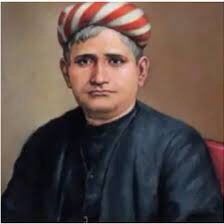
When a man is in doubt what to do , he goes wherever he happens to be first called.
Introduction
Bankim Chandra Chatterjee (also Chattopadhayay) was an Indian novelist, poet and journalist. Chattopadhayay is widely regarded as a key figure in literary renaissance of Bengal as well as the broader Indian subcontinent. Some of his writings, including novels, essays, and commentaries, were a breakaway from traditional verse-oriented Indian writings, and provided an inspiration for authors across India.
Main Works
He was the author of the 1882 Bengali language novel Anandamath, which is one of the landmarks of modern Bengali and Indian literature. He was the composer of Vande Mataram, originally in Sanskrit, personifying India as a mother goddess and inspiring activists during the Indian Independence Movement. Chattopadhayay wrote fourteen novels and many serious, serio-comic, satirical, scientific and critical treatises in Bengali. He is known as Sahitya Samrat (Emperor of Literature) in Bengali. The most noteworthy contribution Bankim made to the nationalistic imagination was the political novel Anandamath which was based on the ‘sannyasi rebellion’ of the late 18th century.

His Views
- Bankim Chandra Chattopadhyay attempted to meaningfully interpret the West for India and India for the West.
- Chattopadhyay’s ideas on contemporary Hindu society and culture reveal a curious mix of liberalism and conservatism.
- He is rightly associated with the burgeoning Hindu nationalism in his day, a sentiment which often resurfaces in several of his novels.
- Bankim hoped that memories would be helpful in generating the nationalist feeling. He felt that the main reason for the lack of nationalist feeling has been because the ‘Hindus’ have not been serious in writing their own history.
- The majority of Hindus and especially the Bengalis have a firm belief in Krishna as god, where Krishna’s influence in people’s lives is far reaching. None start their journey without taking Krishna’s name; none will commence their study without writings Krishna’s name , the beggar will not ask alms without uttering “hail Radha-Krishna” yet on the other hand they have no problem accepting him as a thief in his childhood-who used to eat stolen cream and butter; that in his youth he was a philanderer who seduced innumerable milkmaids away from their marital loyalty; and in his mature age, a swindler and a knave who slew men through deception.
- It is in the ‘Anandamath’ where he best blends nationalism and religion by invoking an image of goddess as mother India.

Unknown Facts
1) He is known as Sahitya Samrat (Emperor of Literature) in Bengali.
2) He was married at the early age of 11, which was a common practice at the time.
3) He wrote the lyrics of ‘Vande Mataram’ well before he penned the novel ‘Anandamath’.
4) He wrote the song ‘Vande Mataram’ on November 7, 1875.
5) Bankim published his novel Anandamath in 1882 which also had verses of ‘Vande Mataram.’ It is a political novel depicting a Sanyasi army fighting the British soldiers. The tune of ‘Vande Mataram’ was later composed by Rabindranath Tagore.
6) Durgeshnandini and Kapalkundala were his first major publications. Both the boys novels were well received and translated into other languages as well.
7) He continued writing novels which gradually gained wide readership. Some of his famous works were were Chandrasekhar and Rajani.

Conclusion
Bankim Chandra Chatterjee’s books and quotations are well-known across India.
He creates quotations while writing his books, and his quotes include some of the world’s most inspiring ideals.
His remarks provide a positive message to the rest of the globe.
 Site Title